For the past two decades, SEO has been simple to measure:
- You track keyword rankings.
- You monitor traffic.
- You optimize for SERPs.
But in 2026, search has fundamentally changed.
With platforms like ChatGPT, Gemini, and Perplexity, users no longer browse 10 blue links. Instead, they get direct, AI-generated answers, often without clicking any website.
This introduces a new challenge:
How do you track your website ranking when there are no rankings?
In AI search:
- There’s no fixed #1 position
- Results vary by prompt and user intent
- Visibility depends on mentions, citations, and authority signals
This guide will walk you through:
- What AI search ranking actually means
- How to track your visibility step-by-step
- Tools, metrics, and frameworks professionals use
- Advanced strategies your competitors are NOT using
What is AI Search Ranking?
AI search ranking refers to:
Your website’s visibility inside AI-generated responses.
Unlike traditional SEO:
| Traditional SEO | AI Search SEO |
| Keyword rankings | Prompt-based visibility |
| SERP positions | Mentions in answers |
| Click-through rate | Citation frequency |
| Backlinks | Authority signals |
Example:
If someone asks:
“Best SEO agencies”
AI might:
- List 8–10 companies
- Cite sources
- Recommend one clearly
If your brand appears there, you are “ranking” in AI search.
Understanding How AI Search Engines Rank Content
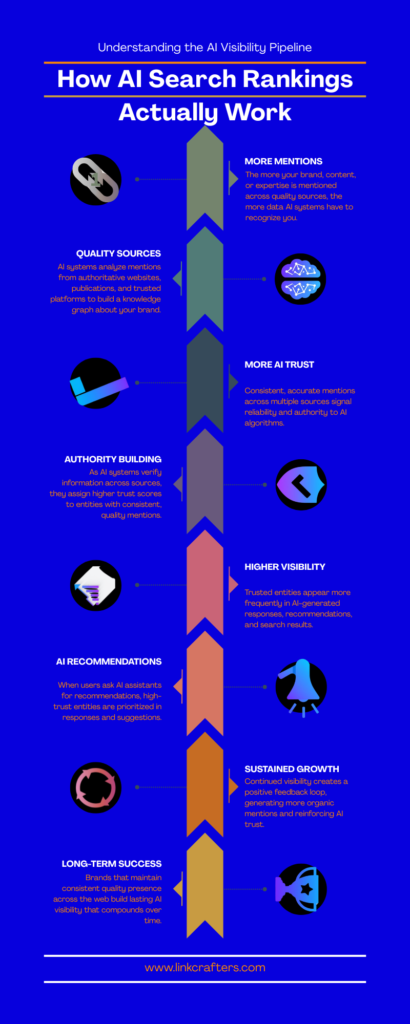
Before tracking, you need to understand ranking behavior. AI systems prioritize several key factors that influence how content is evaluated and surfaced.
1. Authority & Trust Signals
AI search engines heavily rely on authority and trust signals to determine credibility. This includes the presence of quality backlinks pointing to your content, consistent brand mentions across the web, and validation from reputable third-party sources.
Together, these elements signal that the content is reliable and widely recognized.
2. Content Clarity & Structure
Content that is clearly written and well-structured performs better in AI-driven search. This means creating comprehensive guides, using clear and logical headings, and providing direct, easy-to-understand answers that allow AI systems to quickly interpret and extract relevant information.
3. Context Relevance
Relevance goes beyond simple keyword matching. AI systems assess whether the content truly matches user intent and offers sufficient semantic depth.
This ensures that the information provided fully addresses the query in a meaningful and contextual way.
4. Source Credibility
The credibility of the source is another critical ranking factor. Content published on recognized and authoritative domains, along with a strong emphasis on informational accuracy, is more likely to be trusted and ranked higher by AI systems.
Why Tracking AI Search Rankings is Difficult
AI search tracking is inherently complex due to several factors that make it very different from traditional search monitoring.
1. No Fixed Rankings
Unlike traditional search engines that display stable ranking positions, AI systems generate responses dynamically.
This means there are no fixed positions to track, as results can change in real time based on how the AI constructs its answers.
.2. Prompt Dependency
AI-generated results are highly dependent on the specific query or prompt used.
Even slight variations in wording can produce entirely different outputs, making it difficult to measure consistency or establish standard ranking benchmarks.
3. Personalization
Results can vary significantly depending on the user’s behavior, preferences, and context. AI systems may tailor responses based on past interactions or inferred intent, which means two users might receive different answers for the same query.
4. Limited Analytics
Current analytics tools, such as Google Analytics, do not clearly attribute traffic or visibility to AI-generated responses.
This lack of transparency makes it challenging to accurately track performance and measure the impact of AI search.
Step-by-Step Guide: How to Track Website Ranking in AI Search
Step 1: Build a Prompt Tracking Framework
AI search is prompt-driven, not keyword-driven.
What you need:
Create a list of prompts like:
- “Best SEO agencies for SaaS”
- “How to build backlinks in 2026”
- “Top digital marketing companies”
Pro Tip:
Group prompts into:
- Informational
- Commercial
- Transactional
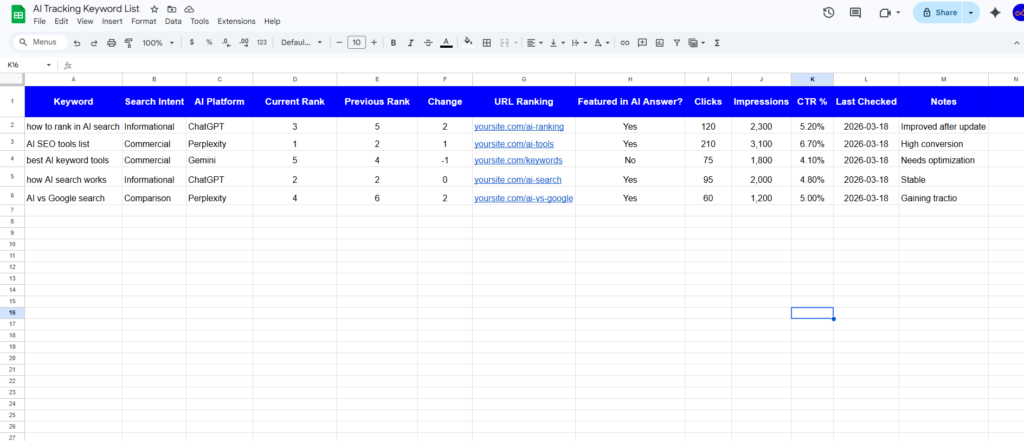
This becomes your AI tracking keyword list. Use a Google Sheet for this. We have made a sample Google Sheet by adding essential elements in it. You can take help from the sheet and make your own sheet too:
Step 2: Perform Manual AI Search Testing
Step 2 is all about performing manual AI search testing using real-world queries. Start by searching your target keywords on platforms like ChatGPT, Google Gemini, and Perplexity AI to see how your content appears.
Analyze whether your brand is mentioned, where it is positioned within the response, and whether competitors are dominating the results.
Pay close attention to which sources the AI platforms cite, as this indicates trust and visibility. Record all findings in a structured spreadsheet to track changes and trends over time.
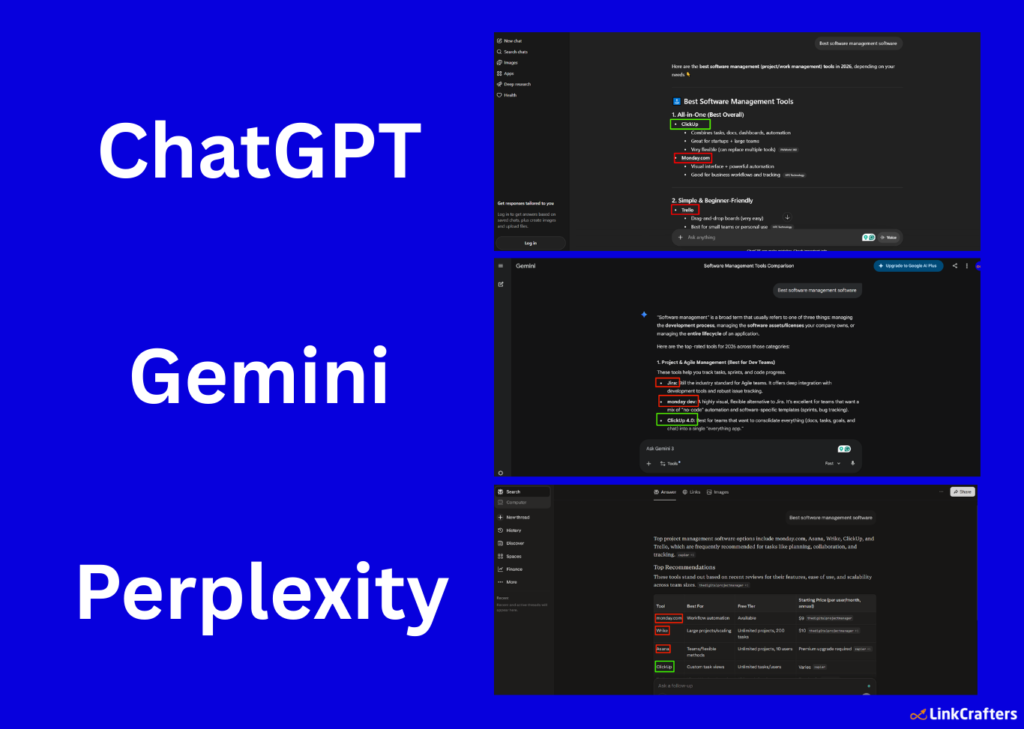
For example, you are from Clikup, and your target keyword is “best software management tools”. Paste your keyword into the AI search bars, and if your site is listed, mark the positions of your website across the different models. Then add these to a maintained sheet to analyze changes over time. Also, track your competitors’ positions to understand how visible they are and where we stand in search results. It helps identify gaps, improve strategy, and increase our chances of ranking higher and getting more traffic.
Step 3: Track Brand Mentions & Citations
In AI search, mentions are the new rankings; visibility depends on how often your brand appears in AI-generated answers. Instead of just tracking positions, focus on how frequently your brand is mentioned, whether your website is cited as a source, and which links AI platforms include in their responses.
Tools like Google Alerts and Ahrefs can help you monitor brand mentions and backlinks across the web. The more consistently your brand is referenced by AI systems, the stronger your overall visibility and authority become.
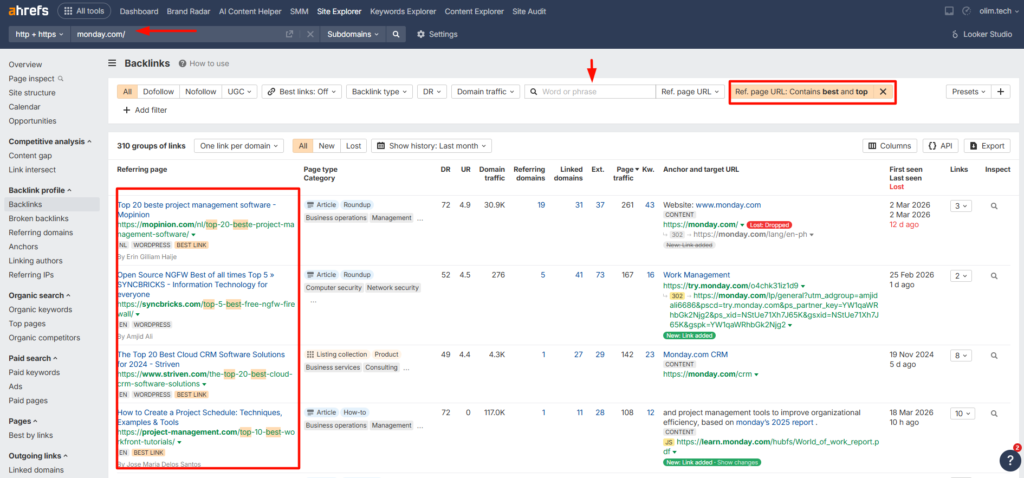
At LinkCrafters, we keep it simple: we find where your competitors are winning and then get you in the game. For a client like ClickUp, we start by plugging their rivals(monday.com) into Ahrefs to see exactly which listicles and articles are mentioning them. Once we have that roadmap, we reach out to those same sites to get our client featured, too. It’s a straightforward, data-driven way to make sure your brand shows up exactly where your customers are already looking.
Step 4: Use AI Search Tracking Tools (Emerging Category)
Using emerging AI search tracking tools that are specifically built to measure visibility across AI platforms. These tools go beyond traditional SEO by tracking how your brand appears in AI-generated responses. Look for features like prompt tracking, AI visibility scores, competitor comparisons, and multi-platform tracking across tools like ChatGPT, Google Gemini, and Perplexity AI.
They typically measure key metrics such as how frequently your brand is mentioned, your share of voice compared to competitors, and your position within AI responses—helping you understand your true ranking in AI search.
The SEO market offers some great free tools to get you started, like Semrush’s AI Search Visibility Checker. You just enter your domain, and it instantly maps out your visibility and positioning across AI search platforms. It’s a perfect way to set a baseline for where you stand and where you can grow. Of course, if you want to dive deeper into the raw data, you’ll eventually need to look at their paid plans.
Step 5: Measure Indirect AI Traffic
measuring indirect AI-driven traffic, which often doesn’t appear in traditional referral reports. To capture this, look for spikes in direct traffic, increased branded searches, and higher engagement on informational or blog pages.
Tools like Google Analytics and Google Search Console can help you identify patterns that indicate AI-driven discovery, giving you insight into how AI is indirectly bringing visitors to your site.
Key Metrics to Track in AI Search
1. AI Visibility Score
Tracks how often your brand appears across different prompts.
2. Citation Frequency
Counts how many times AI references your website.
3. Prompt Coverage
Measures how many prompts trigger your presence.
4. Share of Voice (AI)
Shows your visibility compared to competitors.
5. Position in Response
Being the top mention gives you the highest influence.
Final Thoughts
Tracking website ranking in AI search is not about:
❌ “Where do I rank?”
It’s about:
✅ “Am I being recommended by AI?”
If your brand is:
- Frequently mentioned
- Cited as a trusted source
- Appearing across prompts
👉 You are winning in AI search.
Want to rank in AI search, not just Google?
👉 At LinkCrafters, we help you:
- Build authority signals
- Get featured in AI answers
- Increase visibility across ChatGPT & Google AI
Start dominating AI search today. Feel free to contact us.
FAQs
Can I track my website ranking in AI search like Google rankings?
No, AI search does not provide fixed rankings like traditional search engines. You can’t track a specific “position,” but you can monitor how frequently your website is mentioned and whether it is being used as a source in AI-generated responses.
Which tools can help track AI search visibility?
There are emerging AI SEO tools that track prompt-based visibility and brand mentions across platforms. In addition, traditional tools like Google Analytics and Search Console can help you identify indirect traffic and trends related to AI search.
How do I know if my website is appearing in AI answers?
The most reliable way is to manually test relevant prompts on platforms like ChatGPT, Gemini, and Perplexity. You should check if your brand is mentioned, cited, or referenced when users ask questions related to your niche.
Why does my website appear sometimes but not always in AI search results?
AI responses are dynamic and depend on how a question is asked. Even small changes in wording can produce different answers, which is why your visibility may vary across different prompts.
Is AI search traffic visible in Google Analytics?
Not directly. Traffic from AI platforms often appears as direct or referral traffic without clear attribution. You need to analyze patterns and spikes in traffic to estimate AI-driven visits.
What factors influence AI search rankings the most?
AI systems prioritize content that is clear, authoritative, and relevant. Strong backlinks, brand mentions, structured content, and topical authority all play an important role in improving visibility.
How often should I track my AI search visibility?
Tracking once a week is usually enough to identify trends. Since AI results change frequently, it’s better to focus on patterns over time rather than daily fluctuations.
What is the difference between AI search and traditional SEO?
Traditional SEO focuses on ranking web pages on search engines, while AI search focuses on being included in generated answers. Instead of optimizing for keywords alone, you need to optimize for context, authority, and clarity.
Can small websites rank in AI search results?
Yes, but it depends on the quality and clarity of your content. If your content directly answers questions and is considered trustworthy, it can still be picked up by AI systems even without a large brand presence.