Backlinks remain one of the strongest ranking factors in search engine optimization. Even with AI-powered search, Google updates, and evolving algorithms, links still act as a signal of authority and trust.
But one controversial question continues to dominate SEO discussions:
Should you buy backlinks?
Some marketers say buying backlinks is the fastest way to rank. Others argue it violates Google guidelines and can destroy your rankings.
In 2026, the reality sits somewhere in the middle.
This guide explores everything you need to know about buying backlinks in 2026, including:
- Whether buying backlinks is safe
- Google’s stance on paid links
- Real statistics about link buying
- Risks and benefits
- How to buy backlinks safely (if you decide to)
By the end of this guide, you’ll understand how paid links fit into modern SEO.
What Are Backlinks in SEO?
A backlink is a hyperlink from one website pointing to another.
Search engines treat backlinks as a signal that a page is valuable and trustworthy. If many authoritative websites link to a page, search engines assume the content is useful.
Because of this, backlinks have been a core ranking factor since the early days of search engines.
Why Backlinks Matter
Backlinks influence search performance in several ways:
- Increase domain authority
- Improve keyword rankings
- Help search engines discover new pages
- Drive referral traffic
- Strengthen topical authority
Research consistently confirms the importance of backlinks.
Key Backlink Statistics
| Statistic | Insight |
| 94% of web pages have zero backlinks | Most content never earns links naturally |
| Only 2.2% of pages get links from multiple websites | High-quality backlinks are rare |
| Sites with 30-35 backlinks can generate 10,500+ visits per month | Links strongly correlate with traffic |
| Articles with 900-1200 words attract 75% more backlinks | Longer content earns more links |
Related article: https://linkcrafters.com/blog/link-building-statistics/
What Does “Buying Backlinks” Mean?
Buying backlinks simply means paying another website to place a link to your site.
This typically happens in several ways:
- Sponsored blog posts
- Paid guest posts
- Niche edits
- Link placements within articles
- PR placements on media websites
The goal is to gain backlinks that improve search rankings and authority.
Many SEO agencies offer backlink packages where they handle outreach and placement.
In theory, the process is simple:
- Find a relevant website
- Pay the publisher
- Get a backlink in a published article
- Improve search rankings
But the reality is more complex.
Google’s Official Stance on Buying Backlinks
Google has always been clear about paid links.
According to Google’s webmaster guidelines, buying or selling links that pass ranking signals is considered a link scheme.
This means:
- Paying for links that influence rankings violates guidelines
- Google may penalize websites using manipulative links
However, there is an important nuance.
Paid links are allowed if they use specific attributes.
Approved Paid Link Attributes
| Link Attribute | Purpose |
| rel="sponsored" | Indicates a paid or sponsored placement |
| rel="nofollow" | Tells search engines not to pass ranking signals |
These tags signal that the link is advertising rather than editorial.
However, such links usually do not pass SEO authority.
So while they are safe, they offer limited ranking benefits.
Do SEO Professionals Actually Buy Backlinks?
Despite Google’s stance, buying backlinks is extremely common in SEO.
Industry data suggests that paid links are widely used across competitive industries.
Link Buying Statistics
| Statistic | Source |
| 74.3% of professional link builders admit buying backlinks anonymously | SEO industry survey |
| Only 30% publicly admit it | Same survey |
| Average paid backlink cost in 2025 | $508.95 |
| Backlink industry value | $1.3 billion market |
These numbers highlight how common paid link building has become.
Another study found that 91.9% of SEOs believe their competitors buy backlinks.
This creates an SEO dilemma.
If competitors are buying links and ranking higher, businesses feel pressured to do the same.
Why Companies Buy Backlinks
Buying backlinks can be appealing because it solves one of the hardest SEO problems.
Getting links naturally is extremely difficult.
Studies show:
- 94% of content never earns backlinks
- Only 2.2% of pages receive links from multiple sites
Because of this, many companies choose paid links to accelerate SEO growth.
1. Faster Rankings
Organic link building can take months or years.
Paid backlinks can generate authority signals faster.
2. Competitive Niches
Industries like SaaS, finance, and insurance are extremely competitive.
Without strong backlinks, ranking is nearly impossible.
3. Predictable Link Acquisition
Buying links allows companies to control:
- anchor text
- link placement
- publication timing
4. Authority Building for New Websites
New domains often struggle to earn their first links.
Paid placements can help bootstrap early authority.
Step-by-Step: How to Buy Backlinks Safely
If your strategy includes paid backlinks, follow these steps to minimize risk.
Step 1: Analyze Your Competitors
Start by studying the backlinks of top-ranking competitors.
Use tools like:
- Ahrefs
- SEMrush
- Moz
Look for patterns such as:
- industry blogs linking to competitors
- resource pages mentioning them
- guest posts on niche websites
These sites are potential backlink opportunities.
Step 2: Identify Real Websites
Focus only on websites with:
- real traffic
- consistent content
- topical relevance
Remember:
95% of pages on the internet have zero backlinks, which shows how rare natural links actually are.
This is why quality placements are valuable.
Step 3: Use Outreach Instead of Direct Buying
Instead of directly “buying links,” many SEOs use editorial outreach.
This includes:
- guest posting
- digital PR
- collaboration articles
- expert contributions
This approach produces more natural backlink profiles.
Step 4: Avoid Bulk Link Packages
Never buy offers like:
- 1,000 backlinks for $50
- 500 backlinks in 24 hours
These usually come from:
- automated tools
- private blog networks
- spam directories
Cheap links rarely improve rankings and may harm SEO.
Step 5: Prioritize High-Authority Links
It is better to buy:
- 5 strong editorial links
instead of
- 100 low-quality links.
Research shows high-authority links (DR70+) can have over 5× the ranking impact compared to lower-authority links.
The Risks of Buying Backlinks
While paid links can work, they also carry risks.
Understanding these risks is essential before investing in backlinks.
1. Google Penalties
If Google detects manipulative link schemes, it may apply:
- manual penalties
- algorithmic suppression
- ranking losses
However, manual actions related to link spam are becoming less common because Google often simply ignores suspicious links.
2. Wasted Money
Many cheap backlink packages provide links from:
- spam blogs
- link farms
- automated networks
These links rarely improve rankings.
3. Poor Quality Websites
Links from low-quality sites can damage your authority.
Google evaluates linking sites based on:
- relevance
- content quality
- traffic
- editorial standards
If the linking site is low quality, the backlink may provide little value.
4. Unnatural Link Patterns
Buying many links quickly can trigger algorithmic flags.
Warning signs include:
- sudden backlink spikes
- identical anchor text
- links from unrelated niches
Safe Ways to Buy Backlinks in 2026
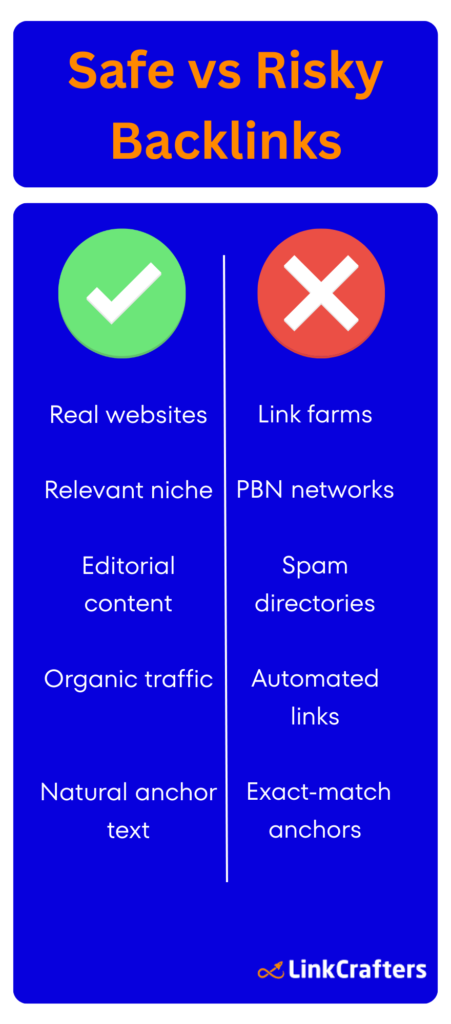
Not all paid links are risky.
Some strategies fall into a grey area and are widely used by professional SEOs.
1. Sponsored Content
Sponsored articles are one of the safest methods.
Benefits include:
- brand exposure
- referral traffic
- editorial placements
These links often include the “sponsored” attribute.
2. Paid Guest Posts
Guest posts remain a popular method.
If done properly, they offer:
- contextual links
- niche relevance
- editorial placement
The key is working with real websites.
3. Digital PR Placements
Many brands pay PR agencies for media coverage.
This can result in links from:
- news websites
- magazines
- industry blogs
These links are highly valuable.
4. Link Building Agencies
A professional link building agency uses outreach to secure placements.
Instead of buying links directly, they:
- pitch content to publishers
- negotiate placements
- publish editorial articles
This approach appears more natural.
Should You Buy Backlinks in 2026?
The honest answer is:
It depends.
Buying backlinks can be effective when:
- links come from real websites
- placements are editorial
- content provides value
- link patterns appear natural
But it becomes risky when:
- links come from spam networks
- packages offer hundreds of links
- sites have no traffic or relevance
The safest strategy is a balanced approach.
Combine:
- organic link building
- digital PR
- guest posting
- strategic paid placements
This creates a natural backlink profile.
Final Thoughts
Buying backlinks is one of the most debated topics in SEO.
Google discourages paid links, yet they remain widely used in competitive industries.
The key takeaway is simple:
Quality matters more than quantity.
Cheap backlink packages rarely work.
But high-quality editorial placements on relevant websites can significantly improve search visibility. If you decide to buy backlinks in 2026, treat them as part of a broader SEO strategy rather than a shortcut.
The best results come from combining:
- content marketing
- digital PR
- organic outreach
- strategic link placements
Backlinks still matter, but the way we build them continues to evolve.
Buying backlinks can accelerate SEO results, but only if the links come from real websites with authority and traffic.
That’s where LinkCrafters comes in.
Instead of spammy link farms or automated backlinks, LinkCrafters focuses on manual outreach and editorial placements on real websites. Every link is placed within high-quality content on relevant sites with genuine organic traffic.
LinkCrafters Pricing Plans
| Plan | Price | Links Included |
|---|---|---|
| Starter | $1,500 | 10 backlinks |
| Plus (Most Popular) | $3,000 | 22 backlinks |
| Growth | $4,500 | 35 backlinks |
| Pay-Per-Link | $150 per link | Flexible campaigns |
All links are delivered within 30 days and come from websites with 1K–100K+ organic traffic and DR 50–90.
Whether you’re a SaaS company, startup, or enterprise brand, LinkCrafters helps build AI-friendly, authority-driven backlink profiles.
Contact us for more details.
FAQs
Does Google penalize websites for buying backlinks?
Google discourages paid links that manipulate rankings. However, modern algorithms often ignore low-quality links rather than penalize sites, especially when the backlink profile appears natural.
How much do backlinks cost in 2026?
Backlink prices vary depending on authority and traffic.
Typical pricing ranges:
- Small blogs: $100–$300
- Authority sites: $300–$900
- Major publications: $1,000–$3,000+
Some agencies also offer packages or monthly campaigns.
How many backlinks do you need to rank?
There is no fixed number. Ranking depends on:
- competition level
- domain authority
- content quality
- topical relevance
- backlink quality
Often a few high-authority links outperform hundreds of low-quality links.
Are backlinks still important for SEO in 2026?
Yes. Backlinks remain one of the strongest ranking signals used by search engines. They help search engines measure authority, trust, and topical relevance.
What are the safest ways to build backlinks?
The safest link building strategies include:
- digital PR campaigns
- guest posting on industry blogs
- partnerships and collaborations
- data-driven content
- editorial outreach
These methods generate natural backlinks that search engines trust.
Should small businesses buy backlinks?
Small businesses can benefit from strategic backlinks, especially in competitive niches. However, the focus should always be on quality links from real websites rather than cheap bulk packages.