Link building has always been a major part of SEO, but not all link-building tactics are created equal. Some help you build long-term authority. Others give you temporary boosts but expose your site to Google penalties.
The second type falls under black hat link building, and understanding these tactics is essential if you want to avoid risks, wasted money, or sudden ranking drops.
In 2026, Google’s algorithms will have become more sophisticated than ever. AI detection, link footprint analysis, and pattern recognition make black hat tactics extremely risky, even when they appear to “work” temporarily.
This guide breaks down what black hat link building is, how it works, common tactics to avoid, how Google detects abuse, and safer, sustainable alternatives.
What Is Black Hat Link Building?
Black hat link building refers to any backlink strategy meant to manipulate search rankings rather than earn links naturally.
These tactics violate Google’s Webmaster Guidelines and are specifically designed to inflate a website’s authority artificially.
Black hat tactics usually involve:
- Links bought in bulk
- Links created through automation
- Links built on low-quality or irrelevant sites
- Manipulative link schemes
- Hidden or deceptive link placements
While these methods may result in short bursts of ranking improvements, they often lead to penalties, deindexing, or long-term loss of trust.
White Hat vs. Black Hat Link Building
| Factor | White hat link building | Black hat link building |
| Definition | Ethical, Google-approved link acquisition focused on real value. | Manipulative techniques used to artificially inflate rankings. |
| Approach | Creating high-quality content, genuine outreach, digital PR. | Buying links, link farms, PBNs, automation |
| Risk Level | Low | Extremely high (penalties, deindexing) |
| Compliance With Google Guidelines | Fully compliant | Violates Google Webmaster Guidelines |
| Longevity | Long-term, stable, compounding results. | Short-term, unstable gains that often disappear. |
| Typical Cost | Higher (quality takes investment) | Lower upfront, but high risk costs later. |
| Link Quality | High-authority, relevant, contextual links. | Low-quality, irrelevant, mass-produced links |
| Impact on Brand Reputation | Positive, improves authority & trust. | Negative, damages reputation if exposed. |
| Suitable For | Businesses focused on long-term SEO growth. | Websites chasing quick, risky ranking boosts. |
| Examples | Guest posting on authoritative sites, HARO, resource link building, content marketing. | Spam comments, PBNs, automated link blasts, link buying. |
Why People Use Black Hat Link Building
Even in 2026, people still fall for black hat tactics because:
- They’re fast
- They’re cheap
- They create a temporary ranking boost
- Many untrained marketers don’t understand the risks
- Some agencies hide them behind fancy names like “private authority networks.”
However, what looks like “quick results” often leads to:
- Manual actions
- Algorithmic suppression
- Lost rankings
- Permanent domain damage
- Loss of trust in Google
Sustainable SEO is always safer and more profitable, which is why many businesses now prefer white-hat link building and high-authority backlinks.
Black Hat Link Building Tactics
Let’s look at the tactics that fall under the black hat umbrella, many of which still circulate in SEO groups, cheap marketplaces, and low-cost agencies.
1. Private Blog Networks (PBNs)
PBN links are one of the most well-known black hat methods. They involve creating or buying a network of expired domains and using them solely to push link authority toward a “money site.”
Here’s the problem:
Google is extremely good at identifying networks using:
- Hosting footprints
- CMS similarities
- Shared IP patterns
- Thin or AI-generated content
- Interlinked networks
Using PBNs in 2026 is more dangerous than ever.
2. Spammy Forum & Profile Backlinks
Forums themselves aren’t bad. In fact, real participation in niche forums can build trust and referral traffic.
However, black hat versions involve:
- Mass-automated forum profile creation
- Thousands of links with generic anchor text
- Content unrelated to your niche
- Spam patterns that Google flags instantly
If you want to use forums legitimately, focus on actual participation instead of automation.
3. Link Farms
These are networks of low-quality sites created with the sole purpose of linking to each other to boost authority. They usually have:
- Zero real traffic
- Thin or duplicated content
- No niche relevance
- Hundreds of outgoing links per page
Google’s SpamBrain system automatically detects these patterns.
4. Mass Directory Submissions
Directories were once a powerful SEO tool. Today, only niche-relevant directories add value.
Black hat marketers, however, submit to:
- Thousands of low-quality directories
- Irrelevant categories
- Automated submission platforms
This creates a toxic backlink profile.
If you want to use directories safely, use curated, high-quality ones.
5. Automated Link Building Software
Tools like:
- GSA SER
- SENuke
- XRumer
…build thousands of links via automation. These links come from:
- Blog comments
- Wiki pages
- Web 2.0s
- Forums
- Profiles
- Directories
This method is extremely detectable and should be avoided at all costs.
6. Tiered Link Building Done Badly
Tiered-link building itself is not black hat when executed legitimately with quality links.
But black hat tiering involves:
- Using spammy links at T2/T3
- Creating automated link pyramids
- Using Web 2.0 spam blasts
Proper tiered-link strategies use quality backlinks, not spam.
7. Buying Links in Bulk
“$49 for 200 backlinks!”
“$99 for 100 DA90 links!”
These packages usually include:
- Blog comments
- Web 2.0s
- PBNs
- Profile spam
- Automated links
- Irrelevant anchors
Google can detect this pattern instantly.
How Google Detects Black Hat Link Building in 2026
Detection is now mostly automated through SpamBrain — Google’s AI system for identifying unnatural patterns.
Here’s how Google spots black hat links:
✔ Repetitive anchor-text patterns
If 80% of your links use exact-match keywords, that’s unnatural.
✔ Irrelevant domains
A finance site getting links from gardening blogs? Very suspicious.
✔ Low-quality content footprints
Thin, AI-generated, or duplicated content signals link manipulation.
✔ Sudden spikes in link velocity
100 new links in 24 hours? Red flag.
✔ Network-wide similarities
Google identifies:
- Shared IPs
- Same hosting providers
- Same CMS templates
- Same footer patterns
- Same website structure
This is why PBNs rarely stay hidden.
Black Hat Links Impact?
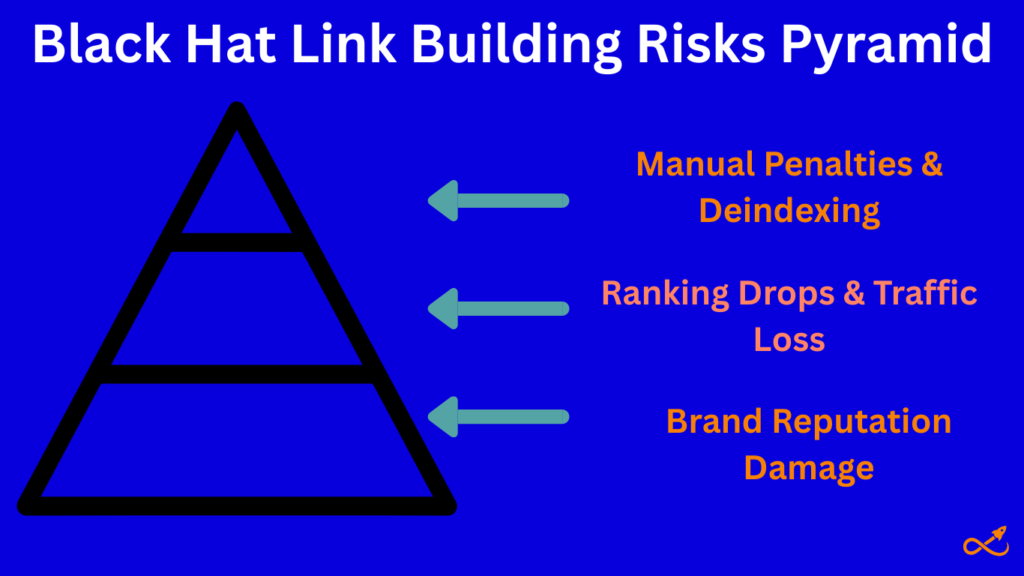
Using black hat tactics can lead to:
❌ Manual penalty
A human reviewer flags your site.
❌ Algorithmic suppression
Your rankings drop quietly without notifications.
❌ Link devaluation
Google ignores all suspicious links.
❌ Long-term authority damage
Google “trust signals” decrease.
❌ Deindexing (worst case)
Pages — or entire sites — disappear from search results.
Once trust is lost, even white-hat efforts struggle to recover.
Final Thoughts
Black hat link building might feel tempting because it promises fast results, but the risks far outweigh the benefits.
With Google’s AI-driven detection systems, manipulative links are easier to identify than ever.
If you want to build rankings that stick, focus on:
- High-quality content
- Ethical link-building methods
- Relevance and authority
- Brand trust signals
- Sustainable strategies
These methods may require more effort, but they build real, long-term success.